Why AI Needs to Sleep
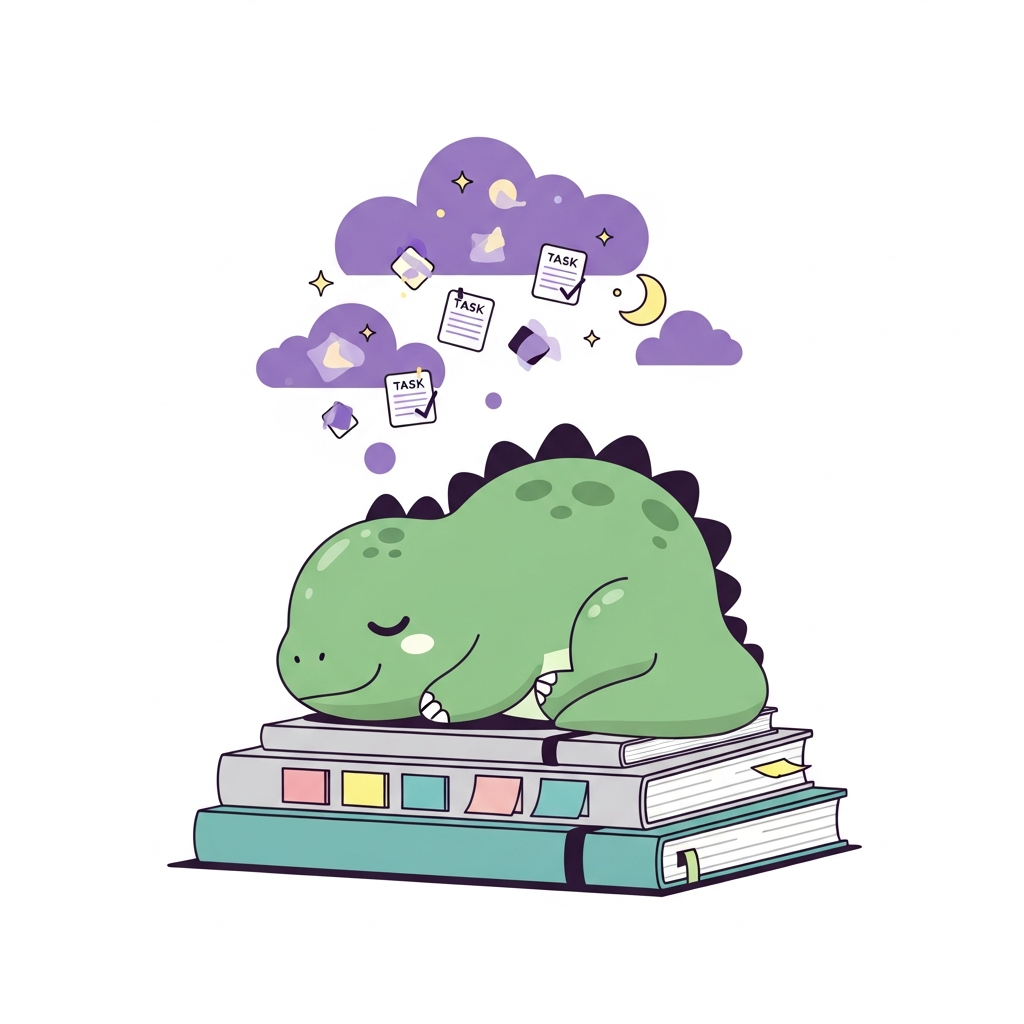
Every night at 3am, TaskZilla sleeps. Not metaphorically — literally. It distills yesterday's chatter into patterns, quietly retires what's already been absorbed, and wakes up a little smarter. Skip that cycle and by week two it's a hoarder with amnesia.
Memory Isn't Storage
Early on we made the obvious mistake: treat memory like a database. Every message, every decision, every standup — stored. Searchable. Forever.
Six weeks later TaskZilla could recall that on February 4th someone said "looks good" in a Telegram thread. It could not tell you how your team actually prefers to review pull requests. The signal was there. It was just buried under 40,000 "looks good"s.
Humans don't work that way. You don't remember every sentence from last Tuesday's standup — you remember the shape of how your team runs standup. That's not compression. That's consolidation, and it happens while you sleep.
What Actually Happens at 3am
Between 3:05 and 3:25 Amsterdam time, TaskZilla runs a four-step cycle across its two memory stores — a graph that tracks entities and relationships, and a vector store that tracks patterns and beliefs.
| Time | Step | What it does |
|---|---|---|
| 03:05 | Chroma prune | Drop vectors that haven't been touched in ages and don't match anything useful. |
| 03:10 | Distill | Read the last batch of raw episodes. Pull out reusable patterns. Write them back as schemas with a confidence score. |
| 03:15 | Reflect | Cross-reference new patterns against old ones. Flag contradictions. Update beliefs. |
| 03:25 | Decay | Any raw episode already absorbed into a high-confidence pattern gets fast-retired. |
Order matters. Prune before distill — you don't want yesterday's garbage contaminating today's patterns. Decay after reflect — you don't retire an episode until you're sure its lesson survived the cross-check.
Why 3am?
Not because the dinosaur is tired. Because nobody's asking it anything. Consolidation is expensive (LLM calls, embedding rewrites, graph traversal) and you want it to happen when the latency budget is zero.
Sleep Isn't Enough
The 3am cycle fixed the hoarding problem. It created a new one: anything you taught TaskZilla at 10am Monday wasn't available as a pattern until Tuesday's sunrise. Up to 21 hours of lag on your own team's operating rules.
So we added a watchdog that can trigger distillation mid-conversation. Three new episodes land, 30 minutes since the last run — it kicks off a background distill on a 2-hour lookback.
The knobs are deliberately boring:
| Knob | Value | Why |
|---|---|---|
| Episode threshold | 3 | Fewer and you're extracting patterns from noise. |
| Cooldown | 30 min | Keeps the watchdog from re-running on the same batch. |
| Lookback | 2 hours | Enough context to form a real pattern. Not so much that you re-process yesterday. |
| Confidence floor | 0.80 | Below this we keep the raw episode. Patterns need evidence, not vibes. |
Result: pattern availability went from up to 21 hours down to roughly 35 minutes. You teach TaskZilla something at 10am, it's operating on that assumption by 10:35.
The Quiet Genius Is Decay
Most memory systems add. Ours subtracts, too. When distillation pulls
a pattern out of three raw episodes with a confidence score above 0.80,
those episodes get tagged schema_absorbed=1. They sit in
a 72-hour grace period, then fast-retire.
Forgetting is not the failure mode. Selective forgetting is the feature.
The raw "On Tuesday, Martin said he prefers small PRs over big ones" goes away. The pattern "Martin prefers small PRs; keep changes scoped" stays. Next time TaskZilla drafts a PR plan, it reaches for the pattern — not for the 14 individual messages it was built from.
Why not keep both forever?
Because retrieval scales with what's in the store. Keep every raw episode forever and pattern lookups slow down, noise creeps in, and eventually the AI starts quoting February 4th's "looks good" at you. Memory that doesn't forget isn't memory — it's a landfill.
Handling Contradictions Without Panicking
Consolidation runs into an uncomfortable problem: sometimes the new pattern contradicts the old one. Two weeks ago the team preferred async standups. This week they switched to voice. Which belief wins?
Neither, automatically. When reflect finds a conflict, it doesn't silently overwrite. It flags the contradiction and asks a human. That rule goes all the way back to an earlier principle we wrote down and refuse to break: the AI doesn't review its own homework.
A switch in how your team works isn't an optimization the AI should make alone. It's a decision. Decisions need people.
What You Actually Notice
You won't see any of this from the outside. That's the point. What you'll notice is the absence of three specific failure modes:
- TaskZilla doesn't re-learn the same thing three times.
- It doesn't get slower over weeks as the memory store grows.
- It doesn't quote random old messages back at you out of context.
Sleep well and the system feels calm. Skip sleep and it feels like a new hire every morning, except the new hire has perfect recall of the wrong things.
Results So Far
- Pattern availability lag: ~21h → ~35min
- Memory store growth: linear in patterns, not in messages
- Recall relevance: up, because the noise is gone
- Sleep window: 20 minutes per night, zero human in the loop unless a contradiction fires
A good memory isn't one that remembers everything. It's one that quietly forgets the right things.
Research credits
The sleep-consolidation loop draws on three published lines of work we took seriously: complementary-memory systems for agents (CMA, 2025), HopRAG-style selective graph traversal (arXiv:2502.12442), and Think-on-Graph bidirectional cross-store bridges (arXiv:2407.10805). The "selective forgetting" rule is older than any paper we read — it's just how human consolidation works. We translated it into cron jobs.